TacMan-Turbo: Proactive Tactile Control for Robust and Efficient Articulated Objects

IEEE Transactions on Automation Science and Engineering (T-ASE) 2026
Zihang Zhao1⚖️;, Zhenghao Qi1⚖️, Yuyang Li1, Leiyao Cui1,2,
Zhi Han2✉️, Lecheng Ruan3✉️, Yixin Zhu1,4✉️,
1Institute for Artificial Intelligence, Peking University 2Shenyang Institute of Automation, Chinese Academy of Sciences
3College of Engineering, Peking University
4School of Psychological and Cognitive Sciences, Peking University
Teaser

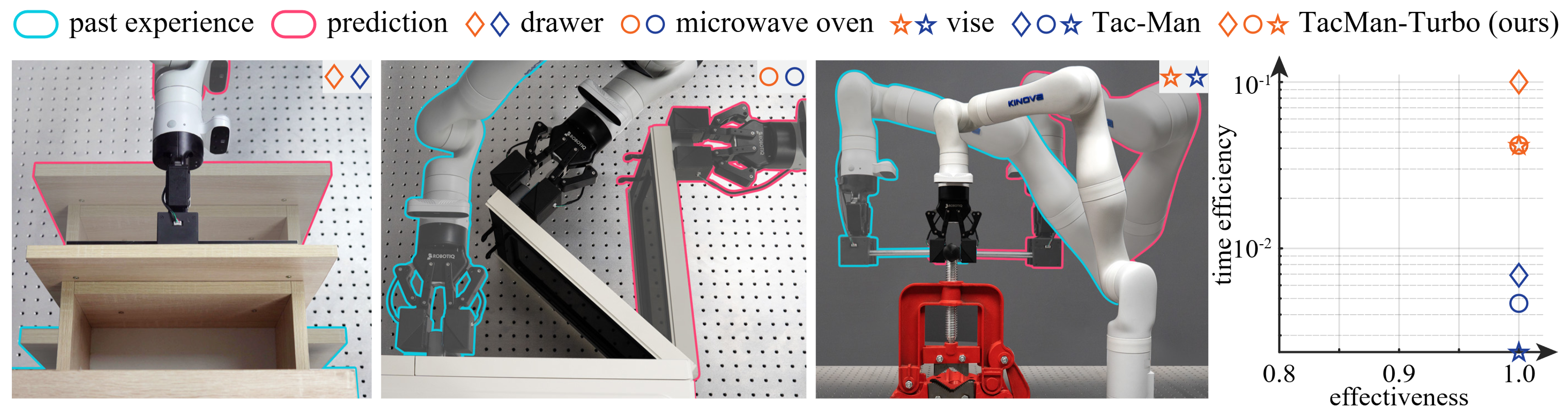
Proactive Tactile Control for Robust and Efficient Articulated Object Manipulation.

Adept manipulation of articulated objects is essential for robots to operate successfully in human environments. Such manipulation requires both effectiveness--reliable operation despite uncertain object structures--and efficiency--swift execution with minimal redundant steps and smooth actions. Existing approaches struggle to achieve both objectives simultaneously: methods relying on predefined kinematic models lack effectiveness when encountering structural variations, while tactile-informed approaches achieve robust manipulation without kinematic priors but compromise efficiency through reactive, step-by-step exploration-compensation cycles. This paper introduces TacMan-Turbo, a novel proactive tactile control framework for articulated object manipulation that mitigates this fundamental trade-off. Unlike previous approaches that treat tactile contact deviations merely as error signals requiring compensation, our method interprets these deviations as rich sources of local kinematic information. This new perspective enables our controller to predict optimal future interactions and make proactive adjustments, significantly enhancing manipulation efficiency. In comprehensive evaluations across 200 diverse simulated articulated objects and real-world experiments, our approach maintains a 100% success rate while significantly outperforming the previous tactile-informed method in time efficiency, action efficiency, and trajectory smoothness (all p-values < 0.0001). These results demonstrate that the long-standing trade-off between effectiveness and efficiency in articulated object manipulation can be successfully resolved without relying on prior kinematic knowledge.

Supplementary Videos

Simulation Studies

Efficient Manipulation

Comparison with Tac-Man

More Examples

Manipulation under Disturbance

Manipulation under Different Initializations

Acknowledgement

Our sincere thanks go to Yuanhong Zeng (UCLA) and Qian Long (UCLA) for their suggestion in driving Kinova, Lei Yan (LeapZenith AI Research) for mechanical design support, Yida Niu (PKU) for demo shooting, Saiyao Zhang (UCAS) for simulation support, and Ms. Hailu Yang (PKU) for her assistance in procuring every piece of raw material necessary for this research. This work is supported in part by the Brain Science and Brain-like Intelligence Technology--National Science and Technology Major Project (2025ZD0219400), the National Natural Science Foundation of China (62376009), the State Key Lab of General AI at Peking University, the PKU-BingJi Joint Laboratory for Artificial Intelligence, the Wuhan Major Scientific and Technological Special Program (2025060902020304), the Hubei Embodied Intelligence Foundation Model Research and Development Program, and the National Comprehensive Experimental Base for Governance of Intelligent Society, Wuhan East Lake High-Tech Development Zone.

BibTeX

@article{zhao2026tacman,
  title={{TacMan-Turbo}: Proactive Tactile Control for Robust and Efficient Articulated Object Manipulation},
  author={Zhao, Zihang and Qi, Zhenghao and Li, Yuyang and Cui, Leiyao and Han, Zhi and Ruan, Lecheng and Zhu, Yixin},
  journal={IEEE Transactions on Automation Science and Engineering (T-ASE)},
  year={2026},
  publisher={IEEE}
}